
The Dopest Route
The Lonely Island / The Beast in Me / Hat Chat


DAD / POP mixtape
“It Takes Time to be a Man” // The Rapture
“Sure Shot” // Beastie Boys
“Against All Odds (Take a Look at Me Now)” // Phil Collins
“She’s Leaving You” // MJ Lenderman
“Lazy Sunday” // The Lonely Island*
It all started with David S. Pumpkins. I showed Maeve the Saturday Night Live sketch around Halloween, and she immediately asked if there was more. I didn’t want to show her the second, dramatically worse, David S. Pumpkins sketch, so I picked a different SNL sketch to show her. This alone was a daunting task. SNL was the first reason and special case for why I was allowed to stay up late as a child. Before I watched it live, I would ask my parents to rent the best-of compilation videos from Blockbuster — Dan Aykroyd, John Belushi, Chevy Chase, Eddie Murphy, eventually Mike Myers and Dana Carvey. I would laugh at these videos until I had to rush out of the room to puke from convulsing so hard. (This is a true story.)
So it wasn’t for lack of encyclopedic knowledge that I didn’t know where to start. I trotted out some classics. “Cowbell” was well-received, “Lunch Lady Land” less so. I tried some character work. Maeve loved “Target Lady” and most of Kate McKinnon’s update desk appearances but absolutely lost her mind at Amy Poehler in “Kaitlyn Gets Her Ears Pierced.” Sketches much older than the new millennium have had an understandably rough go of it for her. Newer sketches about which I’m only luke-warm seem to be speaking her language. She likes the surrealist shorts of Sarah Sherman, she laughed hard at the recent “Jumanji” dinner party scene, and she cannot get enough of the easily exhaustible resource of Please Don’t Destroy videos. Her Gen Z sensibilities — even though she’s technically “Gen Alpha” — are well-established.
But Maeve could not give three shits about the Lonely Island.
I’ve tried. I like the Lonely Island. They belong to the SNL era that I last watched live, the Hader-Wiig-Sudeikis age with Seth Meyers at the desk. In my memory, the show had an energy then that it does not have now. Part of that has to be that that was the last cast that existed between the pre- and post-viral ages of the show; part of it — probably a bigger part — has to to do with me aging. The question of SNL’s energy at any given time is a highly subjective one that follows familiar patterns. To be a pop-culture-literate adult in America is to perceive that Saturday Night Live is always in decline, never as good as when you remember it being the most good.
Anyway, I thought that energy would translate to Maeve. It didn’t. Watching “Lazy Sunday” with her was an excruciating experience. To be fair, I was overly confident. I assumed this was a lay-up. We’d start with the chronic-what?-cles of Narnia and soon progress to “Threw it On the Ground,” “I’m on a Boat,” and other infectious goofs, before selling her on deep cuts like “Space Olympics.” But, mid-way through, when she remained stone-faced through not one but two Alexander Hamilton jokes, I knew I was toast. Normally, when she doesn’t love a sketch, she’ll say something diplomatic like, “that was okay.” But, after “Lazy Sunday,” it was a furrowed brow and a strong head shake.
At the moment, it was a shock. How could something that, to me, represented a teeny tiny televisual revolution, that had a spirit I can only articulate as prankish youthfulness seem so old to Maeve. I listen to the Lonely Island podcast. I know those dudes are middle-aged dads of children Maeve’s age now but they weren’t then. Still and all, it was stale to her. I wonder a little if my enthusiasm dampened the impact a little, but perhaps I’m overestimating the transcendent appeal of a Beastie Boys knock-off comedy group to a child born in the final year of the Obama administration. The TL;DR version of this story is that Maeve didn’t think a thing I thought was cool was cool, and isn’t that just the way it goes. Longterm, raising a daughter with an intuitive distrust of white dudes doing rap parody videos is probably a pretty solid win.
*editorial note: I am no longer presenting these tracks in sequence. Please withhold judgment on the mix as a whole until I’ve finished the essay project and can suss out the appropriate track order. Thanks, Management
STUFF I WROTE
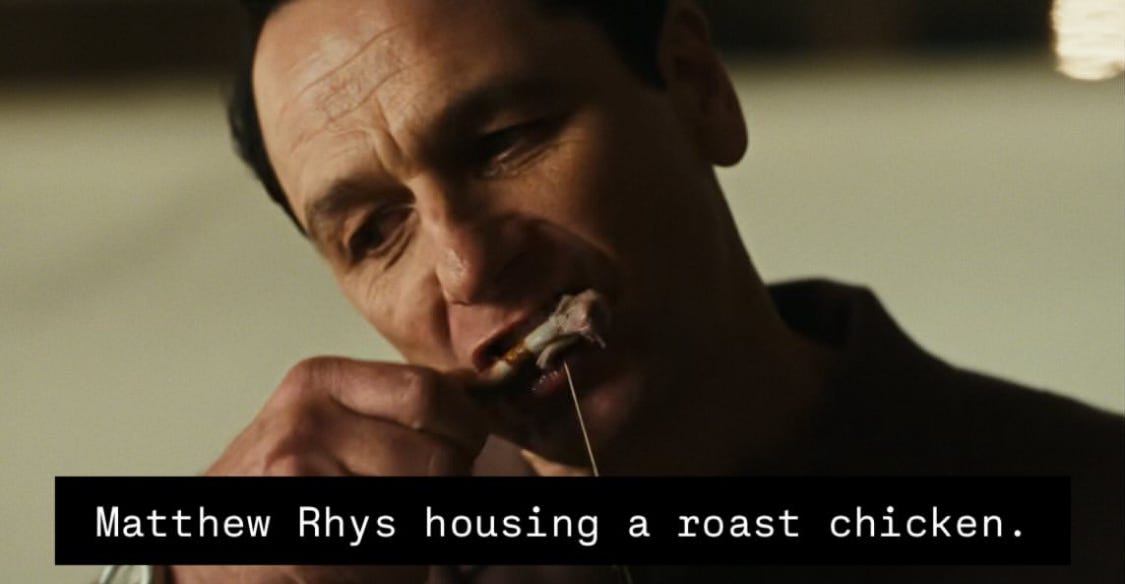
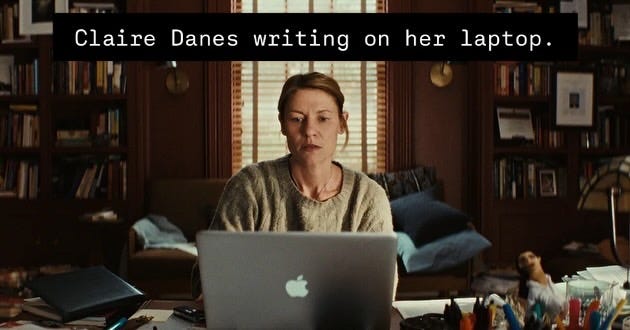
This past week in The New Republic, I covered The Beast in Me, a new limited series on Netflix, starring Claire Danes and Matthew Rhys. Here’s how my review begins:
In the early 2010s, seemingly everybody was talking about how television was in the midst of a “golden age.” This beatification of the medium in the teens emerged out of a long-simmering blog-level conversation about whether and how TV was (or had recently become) an “art form,” but now the conversation was starting to go mainstream, jumping the tracks from the AV Club comments section into popular discourse. “From where I sat,” wrote beloved TV critic Alan Sepinwall in his 2013 book on 2000s television, “TV was in the middle of another golden age.” Journalist Brett Martin’s own 2013 TV book, Difficult Men, called it a “golden age” too, drawing meta-attention to how much critics historically love declaring periods of time to be golden ages. “Welcome to TV’s Second Golden Age,” offered CBS Sunday Morning later that year, and no less an authority than Steven Soderbergh proposed the dawn of a “second golden age of television” from a podium at the Cannes Film Festival. In 2014, in The New York Times, David Carr wrote that he was “barely keeping up in TV’s new golden age,” and, by the end of the year, Vanity Fair was asking, seemingly behind the times: “Are We in a Golden Age of Television?”
The irony is that, by the time these outlets were gleefully gilding a decade of prestige television, the critics were getting antsy again. Just as the golden age was being cast, keen observers of the discourse were beginning to hear tell of a new age, not golden, but silver perhaps? But what, exactly, was TV’s “silver age”? To Andy Greenwald, writing in Grantland (talk about golden ages) in 2012, the TV silver age was an exciting new horizon of creative innovation. Anchored by Showtime’s hit espionage drama Homeland, the archetypal series of the silver age was, “a refreshingly artful hybrid: cable brains spliced with network brawn.” If the golden age prior was about premium cable channels striking out on their own, inventing new forms unburdened by network convention, the silver age was about recasting those tried-and-true network conventions with the high-end production values and sex and cursing of the golden age.
But others imagined this silver age as a time of decline. “With an increase in expectations and a glut of new programming,” Hank Stuever wrote in The Washington Post in 2015, “we’ve become accustomed to shows that are, at their best, pretty good instead of brilliant.” I think, in retrospect, that Stuever’s take is prophetic rather than descriptive. Looking back, many of the shows we might associate with this silver age—Homeland (the first season), The Americans, The Leftovers, The Knick, late Mad Men, late Breaking Bad, Halt and Catch Fire, Louie, Girls—have held up as magnificently rewatchable achievements. Stuever was right to observe the beginning of a decline as more and more shows slapped prestige aesthetics on cookie-cutter clones. But he couldn’t have known how much worse it was going to get. Even in 2015, he couldn’t have seen how bad streaming would make things.
I’m doing all this reminiscing from the point of view of a period that Sam Adams has pretty aptly called, “Trough TV.” It is, in some ways, a nightmare hallucination of Stuever’s concerns about the silver age. Even the best shows are copies of copies, the risk-taking Wild West executives of the golden age have been replaced by private-equity goons playing Moneyball with existing I.P., and they just keep making more and worse Game of Throneses. It’s an era of zombies, so it only seems right that the shows our streamers are currently most interested in zombifying are not even shows of that vaunted golden age, but rather, the silver one. Vince Gilligan has a new show on Apple, so does Jon Hamm. Lena Dunham has one on Netflix, so does Keri Russell. And now, Homeland creator Howard Gordon has reunited with Claire Danes as well as The Americans’ Matthew Rhys to bring us The Beast in Me, a silver age supergroup nostalgia tour, now playing on Netflix. There’s not a lot of new material here, and even the hits don’t quite sound the same.
You can read the rest: here.
Next up in the TNR TV column will be my review of Vince Gilligan’s Pluribus. Stay tuned…
HAT CHAT
One week into the Hat Chat column, and we’re already going off-book. This week, Katie Heindl, of the great great great newsletter Basketball Feelings, had me on to do a guest post reviewing all 30 of the New Era NBA City Edition hats. This was an extremely silly passion project for me, and I hope you’ll check it out here.
As a teaser, I offer you my review of this year’s Utah Jazz hat:

This is a variation of the gorgeous red-yellow-orange gradient City Editions from the Mitchell-Gobert era. Now, imagine that a vampire swept into Utah and drained that design of all of its vital life-force, leaving but a wan, bloodless husk. Salt Lake City’s personal Count Orlok is Danny Ainge, and he has sucked all of the joy from the Utah Jazz organization like a Mormon Nosferatu. Lauri Markkanen and Ace Bailey are trapped in his castle against their will. Walker Kessler is dead. Danny Ainge is an appetite — for the number one pick in the 2026 draft — nothing more.
STUFF I’M WATCHING
Since I last wrote, we started and finished season 5 of Slow Horses, which is slightly less compelling plot-wise than prior installments, but I also think significantly funnier this time around. The improbable, impossible satisfaction of smashing to a full-ass “Next Season on Slow Horses” trailer after every finale is insane. We are now doing a very difficult maneuver, only advisable to professionals, where we simultaneously watch three different shows. I call it The Weave. The shows are: I Love LA (which should be called Hoarse Girls), Death by Lightning (which should be called Garfield & Friends), and a third show I cannot identify due to embargo but that we’re watching on Apple screeners, and which is perfectly named. The shows are, in order: ok, fine, and good.
RECOMMENDATIONS
I had this open as a tab for weeks before I got around to it, but Spencer Kornhaber’s deep dive on the state of cultural criticism gives a lot of texture to a social media landscape that can otherwise seem grimly smooth.
I really enjoyed Alan Sepinwall on TV writer coaching trees.
Coincidentally, Phoebe and I just finished reading The Lion, the Witch, and the Wardrobe together, and, I know it’s a classic, and I know it’s not the hottest take, but C.S. Lewis wrote the heck out of that thing. Reading his conversational, kind of catty narrative voice (especially when he’s just casually ethering Edmund) was just a delight, and it kept Phoebe — who is only just starting to get excited about chapter books that don’t have an illustration on every page — rapt.
How could I not recommend Angelica Jade Bastién’s epic essay, “Black Actresses are Carrying One Battle After Another,” which is one of the finest readings of the film I’ve encountered. Bastién is one of our great analysts of screen performance.
I’ve been reading a lot about “Wages for Housework” as part of my research for the dad book, and so I was very happy to read this excellent omnibus review from Emily Baughan about the contemporary legacies of that movement.
Mel brought home this cookbook called Hot Sheet from the library — it’s all sheet pan recipes — and I made a recipe called “Fish Over Cabbage” from it that’s super simple and very very delicious. I can’t find an online version but, you know what, you have a library card, you know what to do.
Let’s hit up Yahoo! Maps to find the dopest route,
Phil.